
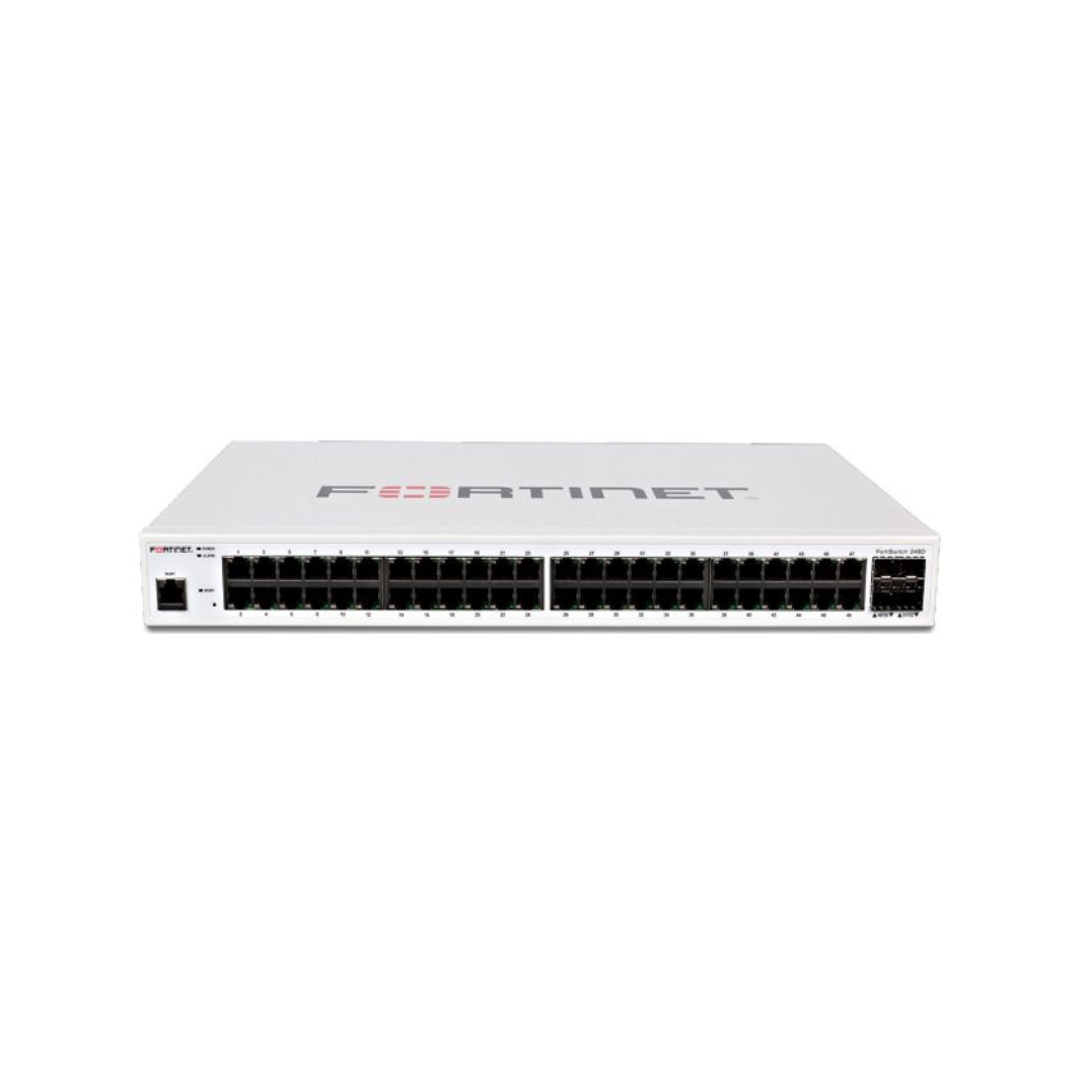
The Fortinet FS-248D is part of the 200 Series switches designed to provide reliable and high performance network connectivity for small to medium sized businesses, distributed enterprises, and branch offices. This switch offers advanced features and capabilities, making it ideal for supporting various network devices, including access points, IP phones, cameras, and other devices. With its twenty four Gigabit Ethernet ports, the FS-248D provides ample connectivity for growing networks while ensuring efficient and secure data transmission.
Key Features
Twentyfour Gigabit Ethernet Ports: The FS-248D features twentyfour 10/100/1000BaseT Ethernet ports, providing highspeed connectivity for network devices.
Layer 2 Switching: Implements Layer 2 switching functionality to facilitate efficient data forwarding and network segmentation.
Advanced Security Features: Incorporates security features such as VLAN support, port mirroring, and access control lists (ACLs) to enhance network security and compliance.
Easy Management: Offers centralized management and configuration through FortiGate security appliances or FortiManager network management platform, simplifying network administration.
Redundancy and Resiliency: Supports link aggregation (LAG) and redundant power supply (RPS) for enhanced network reliability and uptime.
Technical Specifications
Model: FS-248D
Ports: 24 x 10/100/1000BaseT Ethernet ports
Switching Capacity: Up to 56 Gbps
Forwarding Rate: Up to 41.7 Mpps
Form Factor: Rackmountable (1U)
Management: Managed
Applications
The Fortinet FS-248D switch is suitable for a variety of applications, including:
Small to Medium Sized Businesses (SMBs): Providing reliable and highspeed connectivity for computers, printers, servers, IP phones, cameras, and other network devices in SMB environments.
Branch Offices: Supporting network connectivity for remote branch offices and satellite locations, enabling seamless communication and collaboration.
Education: Connecting classrooms, administrative offices, and campus wide Wi-Fi access points in schools and educational institutions.
Hospitality: Powering guest Wi-Fi access points, IP phones, security cameras, and other guest services in hotels, motels, and resorts.
Healthcare: Connecting medical devices, patient monitoring systems, administrative equipment, IP phones, and security cameras in medical offices, clinics, and hospitals.